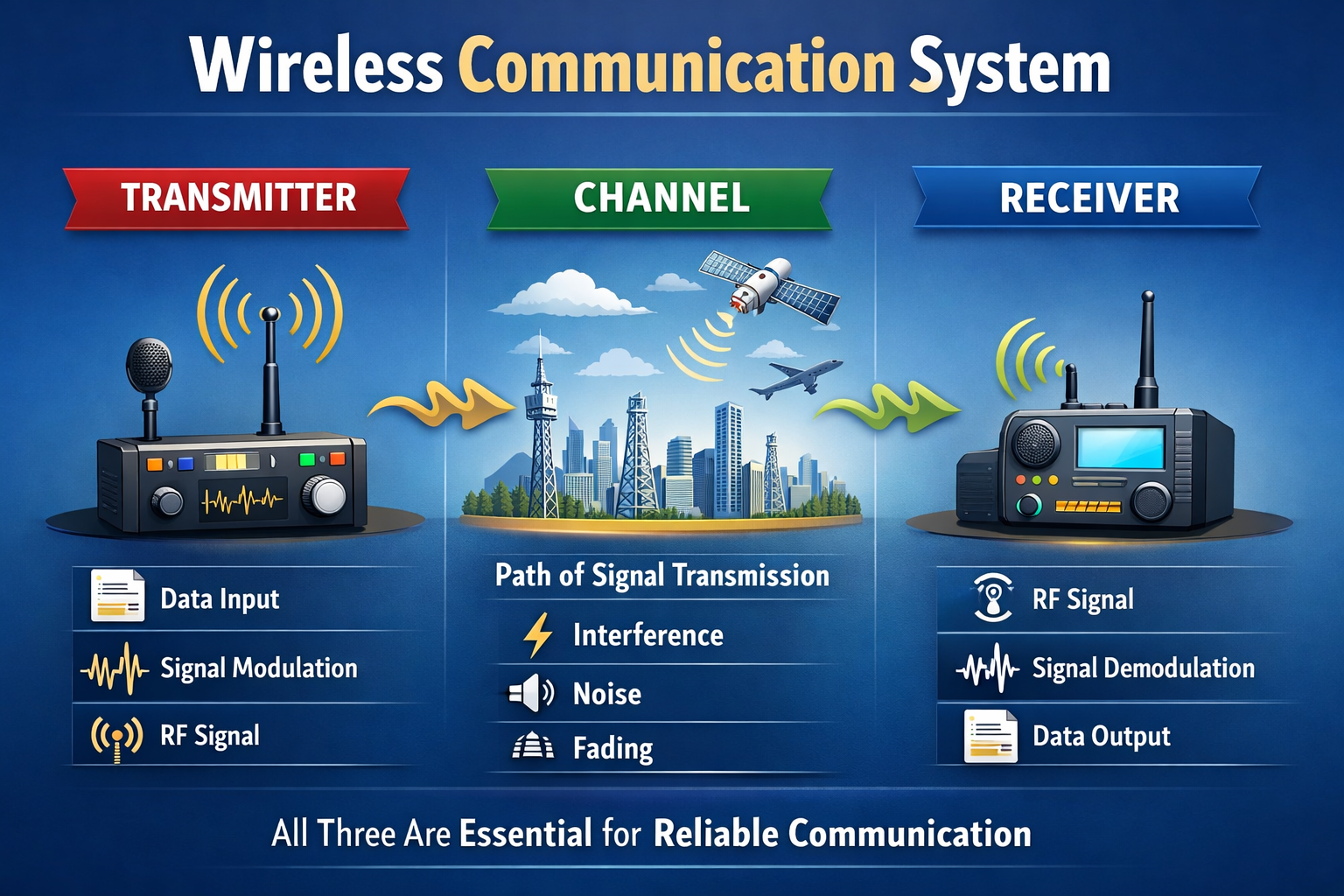
When we talk about wireless systems, we often separate the world into two clean blocks: transmission and reception. The transmitter sends. The receiver listens. In textbooks and block diagrams, everything looks neat and well-behaved.
Reality, of course, is way messier. And that's where most of the learning happens.
At the transmitter, everything seems certain. Bits are mapped to symbols, symbols to waveforms, power is allocated, and the signal leaves the antenna exactly as designed. On paper, the signal is perfect. In simulations, it behaves at a controllable extent. Yet even before it leaves the antenna, real systems introduce imperfections. Nonlinearities, quantization noise, phase noise, and hardware mismatch all shape the transmitted waveform. The signal that leaves the antenna is only an approximation of the ideal.
Once the signal leaves the antenna, even the partial control is gone. The wireless channel does not care about how elegant your modulation is or how carefully you optimized your waveform. It reflects, diffracts, attenuates, distorts, and sometimes almost disappears. Distance, obstacles, motion, interference, hardware imperfections, and noise all join the party. None of them asked for permission.
By the time the signal reaches the receiver, it is no longer what was transmitted. It is a shadow of it.
This is where reception becomes more than just "the inverse of transmission." The receiver is not simply undoing what the transmitter did. It relies on informed judgment supported by experience and data. Every synchronization step, every channel estimate, every decoding decision is a balance between confidence and uncertainty.
Take something as basic as timing. If the receiver is off by a tiny fraction of a symbol, everything downstream suffers. Frequency offset adds slow rotation. Phase noise adds jitter. None of these effects are dramatic on their own, but together they shape performance far more than most ideal assumptions.
Sometimes we over-optimize the transmitter, assuming the receiver will "figure it out." Other times we build extremely clever receivers, assuming the transmitted signal is perfectly clean. Both assumptions break quickly in real deployments.
This mirrors how we work in real life. We often think we "communicated" an idea clearly, only to realize it was "received" under different assumptions, noise, or context. Misunderstandings are not always errors. Sometimes the channel was just harsh that day. Other times, the message itself was imperfect, or the listener had limitations they did not account for. Often, it is a combination of both.
In wireless, we do not fix this by pretending the channel is ideal. We fix it by modeling uncertainty, building robustness, and accepting that not everything will be perfectly recovered every time. That mindset is emotional intelligence applied to real life.