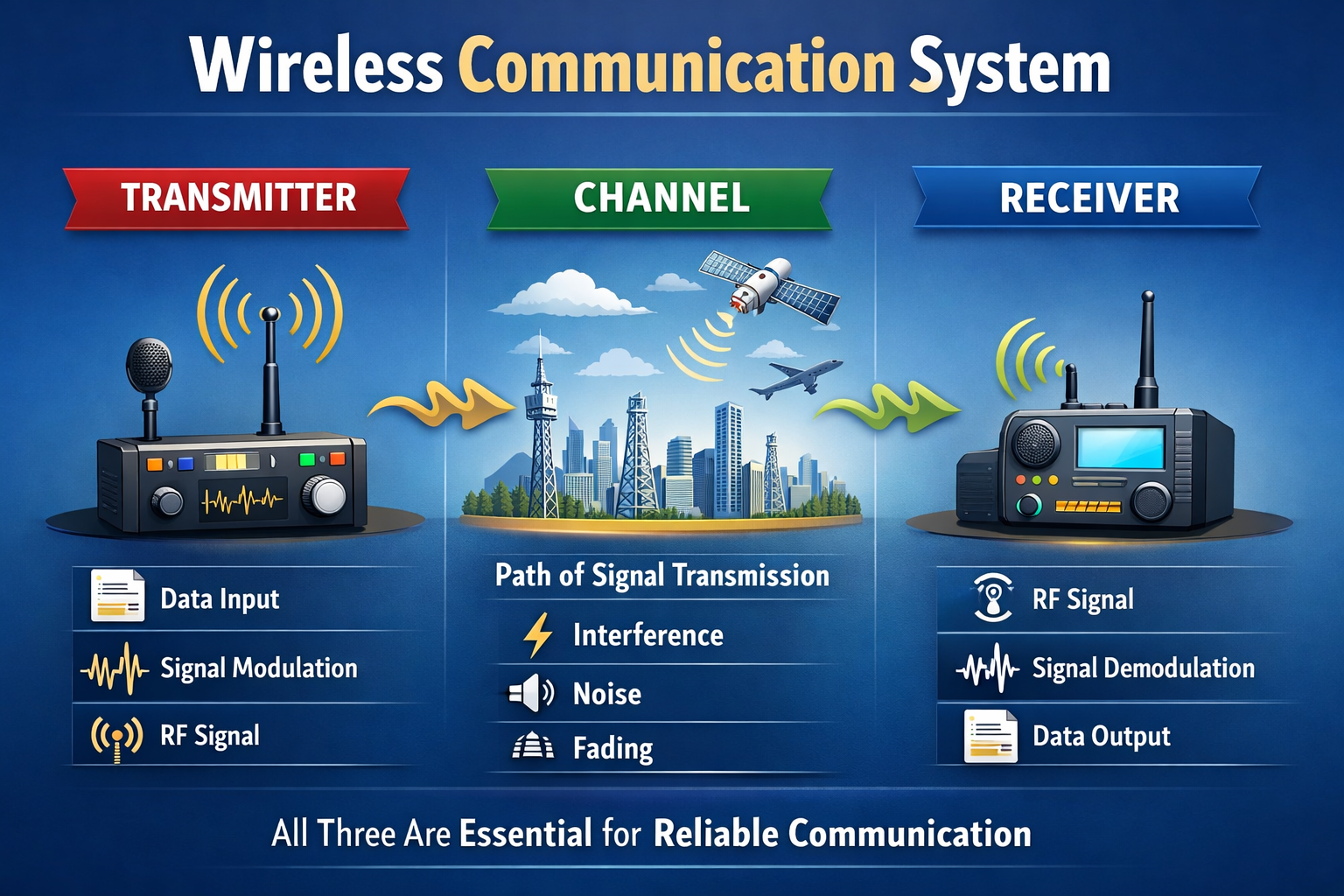
Signal to noise ratio is one of the simplest ideas in wireless systems — and one of the most powerful metaphors for focus, resilience, and cutting through noise in everyday life.
Understanding the messy reality of wireless communication beyond textbook models.
Explore how the Fast Fourier Transform powers everything from voice assistants to 5G networks.
How wireless technology evolved from single antennas to adaptive MIMO systems.
How Alamouti coding transformed wireless communication with elegant simplicity.
The adaptive mechanism that balances speed and reliability in modern wireless.
The hidden complexity behind "perfect channel knowledge" assumptions.
How Wi-Fi 7's MLO feature uses multiple links simultaneously for better reliability and throughput.
Learn how modern Wi-Fi avoids interference by selectively using portions of wide channels.
How Wi-Fi 6 and 7 slice spectrum to serve multiple users simultaneously.
Why ReLU became the activation function that unlocked modern neural networks.
Einstein's theories at work in your daily navigation.
How Bayesian estimation and the Cramér-Rao bound help us make better guesses.
Progress doesn't have to be perfect to matter.
The hidden mathematics powering facial recognition, Google search, and more.
How EM iteratively estimates parameters when data has missing or hidden parts.
Multiple Signal Classification technique for detecting signal direction in 5G and WiFi.
How Maximum Likelihood Estimation powers everything from noise-canceling headphones to medical diagnoses.